Building owner
Characteristics of hemp lime
What you should know about planning
Light stones
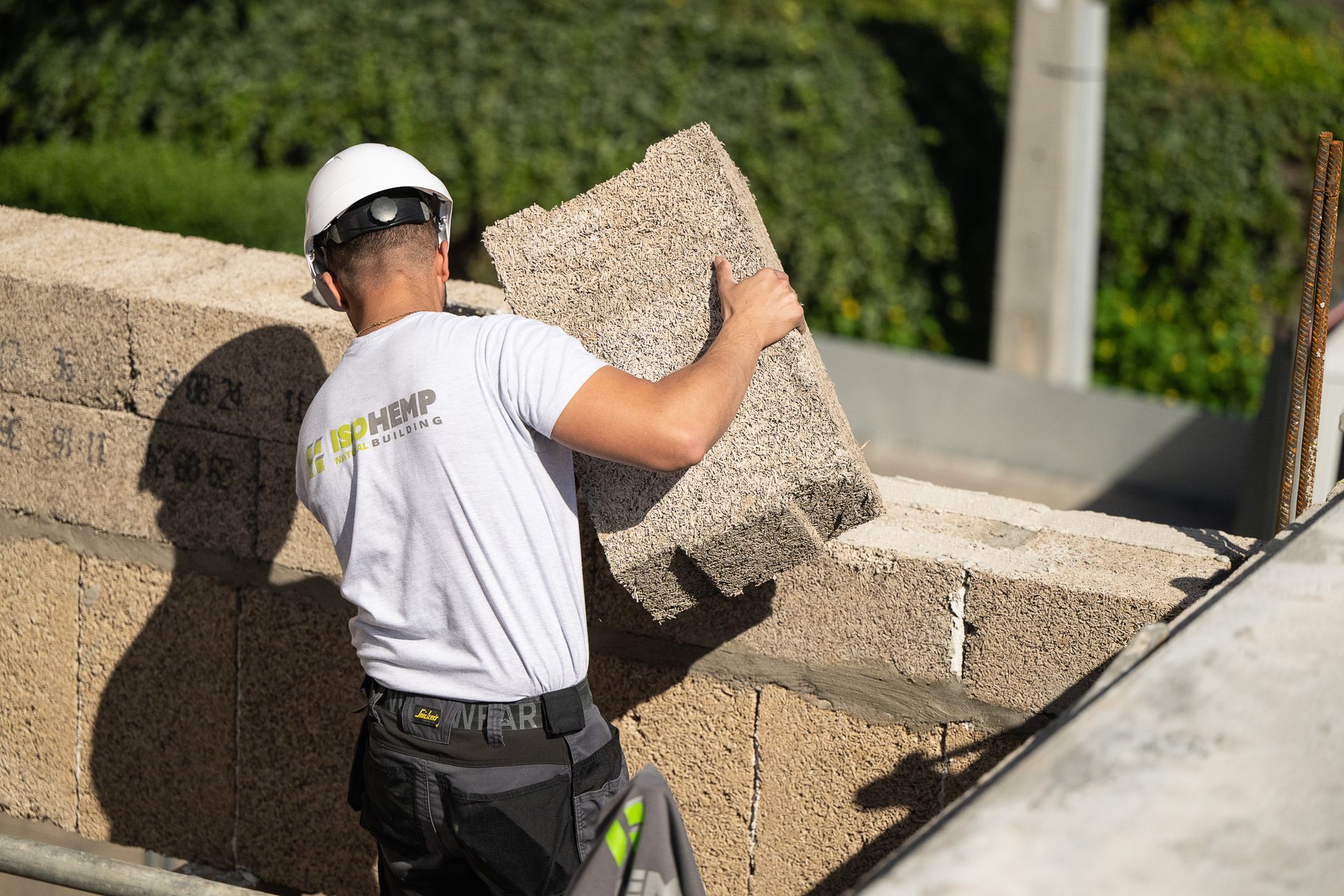
Hemp limestones are defined by their low weight, they have a density of about 300 to 400 kg per m³.
Heat insulating and regulating
Hemp limestones are able to store, reflect and conduct heat. In summer, for example, they provide a cool temperature, whereas in winter they keep the heat in the house.
Indoor air
There are no vapours that could pollute the indoor air, as hemp lime is produced free of glue, adhesive, plastic and the like. Hemp lime bricks are composed of hemp hurds (waste products from the food and textile industry), lime, water and minerals.
Water-absorbent
Hemp can absorb water up to four times its own weight in just one minute and thus regulates the moisture balance.
Fire resistance up to EI 240 (36 cm, plastered)
They are very flame retardant and resist fire for more than 2 hours. They also meet reaction to fire class B-s1,d0 according to EN 13501-1
ideal room climate
Hemp lime can absorb and release moisture (no wetness remains on the wall surfaces) and thus buffers fluctuations in indoor humidity.
Pest resistant
Compared to wood, hemp limestones are resistant to insects as well as rodents.
Soundproofing
They help to dampen and absorb most of the sound waves. The sound insulation value of hemp lime is 37 to 45 decibels.
Circularity
Hemp-lime blocks are long-lasting and consist of hemp shiv and lime. In addition, hemp plants grow approx. 50 times faster than wood, and the material for an entire house can be obtained from a field of just one to two hectares.
Nevertheless, it is important to note that hemp lime is not load-bearing, which means that it is not designed to support roofs, for example. In order to be able to build with it, it is important to have a load-bearing wooden framework beforehand, for example, so that the walls are stabilised. werden.